|
Click on rows below to see
more details.
About Us

Colin McNaught was born in Newcastle, England and grew up in a seaside town in Northumberland on the Northeast coast. His parents and uncle were very active in English and Scottish Folk Music and Dance. At an early age he was exposed to a lot of Folk and Dance music and heard the Northumbrian Smallpipes first played by a family friend. He started playing music early, with recorders and was classically trained on the oboe and flute and played at School and University in Newcastle and Cambridge. The unique sound of the Northumbrian Smallpipes was memorable but it took him over 50 years from hearing them to decide to take them up as a player in 2005. The set of pipes he is playing were hand crafted by Richard and Anita Evans in the North of England near the Scottish border and are in the traditional key somewhere between F and F#.

Christian Crowley combines folk instruments with new styles in traditional and unusual settings. In the Washington, DC area he plays with Djesben (world-groove) and Haunted Bordello (down-tempo traditional), and develops multi-media storytelling performances with FireFlight Productions. Christian also hosts art openings on the second Saturday of each month at the GallAerie, his group home in Mount Pleasant. Christian is learning the Northumbrian Smallpipes so we can anticipate some pipe duets in the future. In these pieces, Christian is playing Dulcimers made by Blue Lion in California, a standard 4-string model and a 6-string version with added bass strings.

Cheryl Tauber McNaught started playing flute as a youngster in concert bands, concerto groups and orchestras. In the 1970's she studied jazz and played music in L.A., CA. Upon meeting Colin they discovered they both played flutes. Duet concerts for friends and family became a part of their social scene. Cheryl began playing the concertina in 2008 and plays in the tradition of Folk dance music and Sea Shanties.
 Listen/Follow Colin on SoundCloud
|
About Our Instruments
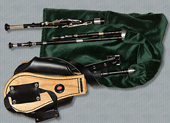
Northumbrian Smallpipes evolved in the 17th century in the area bordering England and Scotland. They are named after the county of Northumberland, which lies between the Scottish Border to the North, the North Sea to the East and the River Tyne and Hadrian's Wall to the South. Unlike the more well-known Greater Highland Pipes:
- Wind is provided not from blowing but from a set of bellows positioned under the right arm.
- The chanter, which provides the melody, is closed at the end. This makes the sound quieter, changes the fingering completely, and allows the playing of separated notes unlike the Highland Pipes which are always 'on'.
- The chanter is often made with keywork to add sharps and flats and extend the range of the instrument up to two octaves. This allows a more varied repertoire of Dance and Folk music in different key signatures.
Like the Highland Pipes, the Northumbrian Smallpipes have tunable 'drones' providing continuous tones that accompany the melody and contribute to the instrument's unique characteristics.
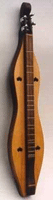
The Appalachian Dulcimer is a fretted stringed instrument usually played on the lap with three or more strings strummed, plucked or even bowed. The instrument first appeared in the early 1800s from the Scots-Irish in the Southern Appalachian Mountains, and is thus also called a Mountain Dulcimer. It began to be used as a parlor instrument, as its sound volume is appropriate for small home gatherings. The instrument has no known precedent in Ireland or Scotland. However, several diatonic fretted Zithers exist in Continental Europe, which bear a strong similarity to the dulcimer. Typically, two of the strings (drones) will sound the same note throughout a piece of music so the instrument is well-suited to accompany the pipes.
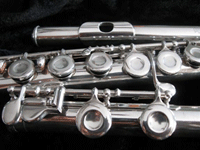
The Flute Cheryl is playing on this music is a Haynes Boehm system made in 1968.
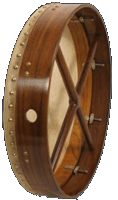
The Bodhrán (pronounced boran) is an Irish circular frame drum with a skin head tacked to one side. The other side is open ended for one hand to be placed against the inside of the drum head to control the pitch and timbre. One or two crossbars, sometimes removable, may be inside the frame.
There is evidence that during the Irish rebellion of 1603 the Bodhran was used by the Irish forces as a battle drum, or that the drum provided a cadence for the pipers and warriors to keep to, as well as to announce the arrival of the army. This leads some to think that the Bodhrán was derived from an old Celtic war drum.
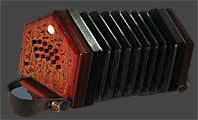
The Anglo Concertina is historically a hybrid between the English and German types of concertinas. The button layouts are generally the same as the original 20-button German concertinas designed in 1834. Due to its popularity in England, English manufacturers began offering their own versions built using traditional English methods which became known as 'Anglo-German'. Use of the "German" part of the title Anglo-German ceased in the UK during World War I. "Anglo" concertinas differ from "English" Concertinas primarily in that each button produces a dfferent note when 'pushed' or 'drawn'. Cheryl plays a 30 button 'D' concertina manufactured by Bob Tedrow in Birmingham, Alabama in 2007.
|




 Colin McNaught - Northumbrian Smallpipes
 Christian Crowley - Appalachian Dulcimer
 Cheryl McNaught - Flute, Concertina, Bodhran
 Northumbrian Smallpipes
 Appalachian Dulcimer
 Flute
Flute Bodhran
 Anglo Concertina